Financial Automation
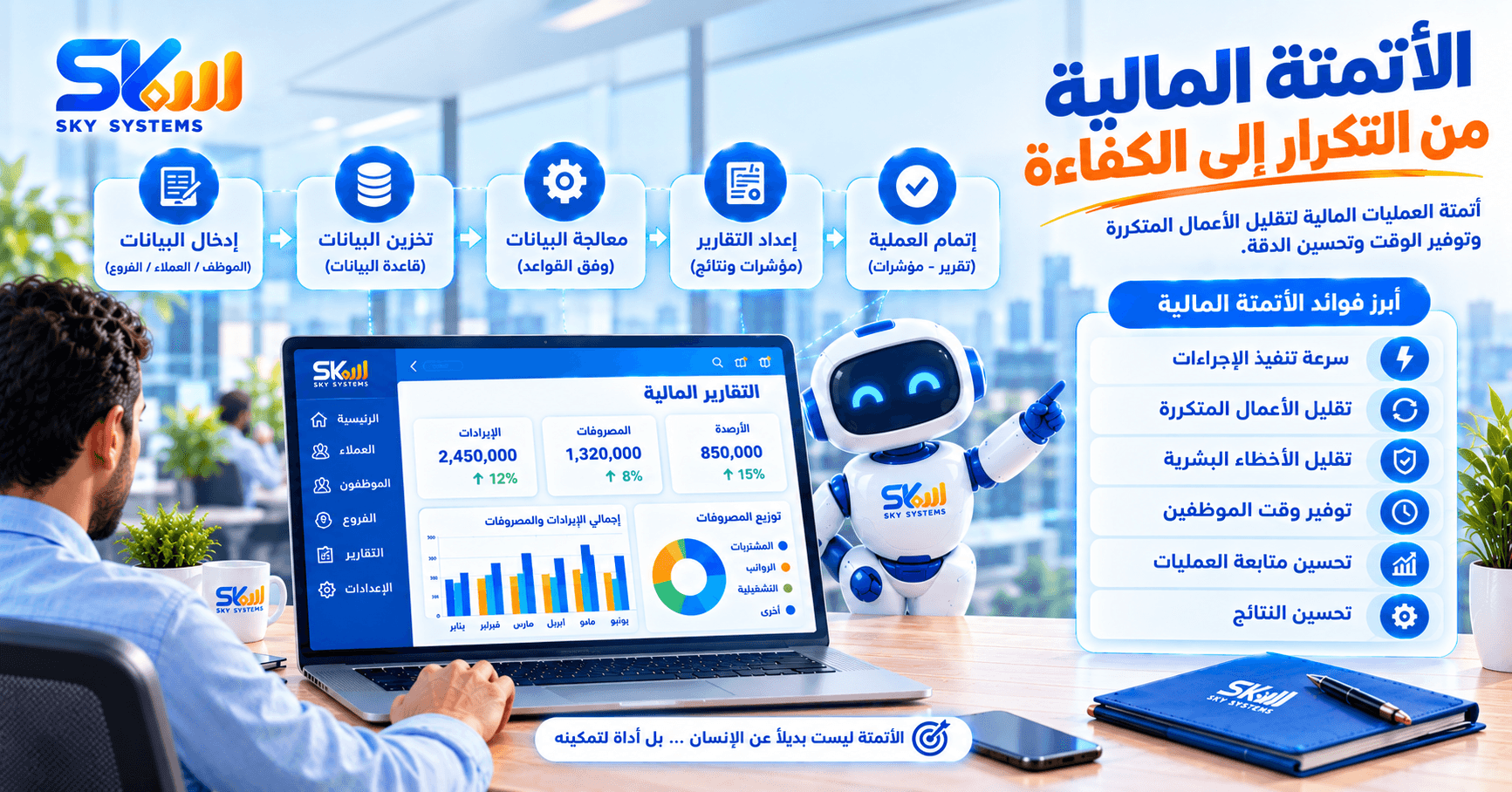
What Is Financial Automation?
Automation means using a system to perform repetitive steps or procedures according to defined rules, instead of requiring an employee to perform every step manually each time.
For example, depending on the system’s design, it may help create certain transactions, update data, issue notifications, or perform repetitive procedures according to specific conditions.
But automation does not mean that the system makes every decision instead of people.
It means that tasks and processes that can be organized in advance can be carried out more automatically.
Why Do We Need Automation?
Because repetition takes time.
And as a company grows, the number of repetitive tasks increases.
If an employee performs one task ten times a day, it may not seem like a problem.
But when that same task needs to be performed hundreds of times, the amount of time it consumes becomes significant.
More importantly, repeated manual data entry can increase the possibility of errors.
This is where automation can help.
How Does Automation Reduce Repetitive Work?
Suppose there is a process that always follows the same steps:
Receive data
↓
Check a specific condition
↓
Record the transaction
↓
Update the data
↓
Send a notification
Instead of having an employee perform all these steps manually every time, the system can automate some of them according to the available rules and capabilities.
This allows employees to focus on the parts that require intervention, review, or decision-making.
Does Automation Mean Replacing Employees?
This is one of the most common misconceptions.
Automation does not necessarily mean replacing employees.
In many cases, the goal is to reduce repetitive work so employees can focus on tasks that require human interaction, review, or decision-making.
Machines are good at performing repetitive steps.
People, however, remain essential for monitoring, customer service, problem-solving, reviewing, and making decisions.
Can Everything Be Automated?
No.
Not every process is suitable for automation.
Some procedures require human judgment.
Some transactions require review or approval.
And some situations are unpredictable and cannot easily be converted into fixed rules.
That is why automation should begin with a simple question:
What process is being repeated?
Then:
Can its steps and rules be clearly defined?
If the answer is yes, automation may be a suitable option.
What Happens If the Process Itself Is Not Organized?
This is where an important challenge appears.
If the way of working is disorganized, automation may not solve the problem.
It may simply make the disorder faster.
That is why, before automating any procedure, the process itself needs to be understood:
What are the steps?
Who is responsible?
What data is required?
What are the different possible scenarios?
When is approval required?
And when does an employee need to intervene?
Good automation starts with a clear process, not simply with a desire to use technology.
How Does Management Benefit from Automation?
When repetitive tasks are reduced, a company can benefit from:
Faster execution of procedures.
Less repetitive data entry.
Fewer manual errors.
More time for employees.
Better transaction monitoring.
Faster notifications and updates.
More organized processes.
But the value of automation is not measured only by the number of automated processes.
The real question is:
Has the way of working become better?
In the End…
Automation is not simply a button that makes the system work on its own.
It is a way of reorganizing repetitive work so that the system performs what can be defined and organized in advance, while employees focus on tasks that require monitoring, decision-making, and interaction.
Good technology does not make employees work more… it helps them spend their time where the business actually needs it.
Discover Sky Systems Solutions for Automation and Business Management →