Exchange Company Systems
How Can a System Help an Exchange Company Manage Its Daily Operations?
But what happens when these operations are repeated dozens or hundreds of times throughout the day?
How can the company know what has been completed?
How can it monitor the activity of each branch?
How can it know which employee carried out each transaction?
And how can management gain a clear picture of the company’s overall status?
This is where an Exchange Company Management System comes in.
The system is not limited to recording transactions. It helps organize data and connect related operations, making the information generated throughout the company’s daily activities clearer and easier to monitor.
Every Transaction Starts with Data
When a customer enters an exchange company, a new transaction begins.
It could be a currency sale, a currency purchase, a money transfer, or another financial service, depending on the nature of the company and its system.
The required information is entered, such as the customer, currency, amount, exchange rate, transaction type, and other necessary details.
But an important question arises here:
What happens to this data after it has been entered?
From Data on the Screen to a Recorded Transaction
When a transaction is processed through the system, the data does not remain simply as numbers displayed in front of the employee.
The transaction is recorded in the system according to the approved procedures, permissions, and configurations, allowing it to be retrieved and tracked later.
This means that the transaction becomes part of the company’s records.
Depending on the nature of the system, it can be linked to customer, employee, branch, currency, amount, date, and other relevant details.
But what happens when the company deals with more than one currency?
Currencies and Exchange Rates
Exchange companies deal with different currencies, and each currency may have an exchange rate that changes according to the market and the company’s policies.
Therefore, the company needs an organized way to manage the currencies and rates used in its transactions.
Depending on its capabilities and configuration, the system can help organize currency and exchange-rate data and link it to the transactions being processed.
This makes the transaction clearer:
Currency + Rate + Amount + Transaction Type = Financial data that can be recorded and tracked.
But as the number of transactions increases, is recording each transaction separately enough?
As Transactions Increase… the Need for Organization Begins
At the beginning, the number of transactions may be limited, allowing employees to follow most details easily.
But as the company grows, the volume of daily operations increases.
Currency sales and purchases, remittances, customers, branches, expenses, revenues, and other activities all need to be recorded and monitored.
With this volume of data, relying on scattered files or manual procedures becomes increasingly difficult.
Searching for an old transaction may take time, and management may need to collect data from multiple sources just to prepare a single report.
This is where the value of having a system that brings transactions together in one organized environment becomes clear.
But what happens when the company operates from more than one branch?
What Happens When the Company Has Multiple Branches?
Having multiple branches means more employees, customers, transactions, and data.
Management therefore needs to know what is happening at each branch.
How many transactions have been processed?
What is the volume of activity?
Which transactions have been completed?
Who carried them out?
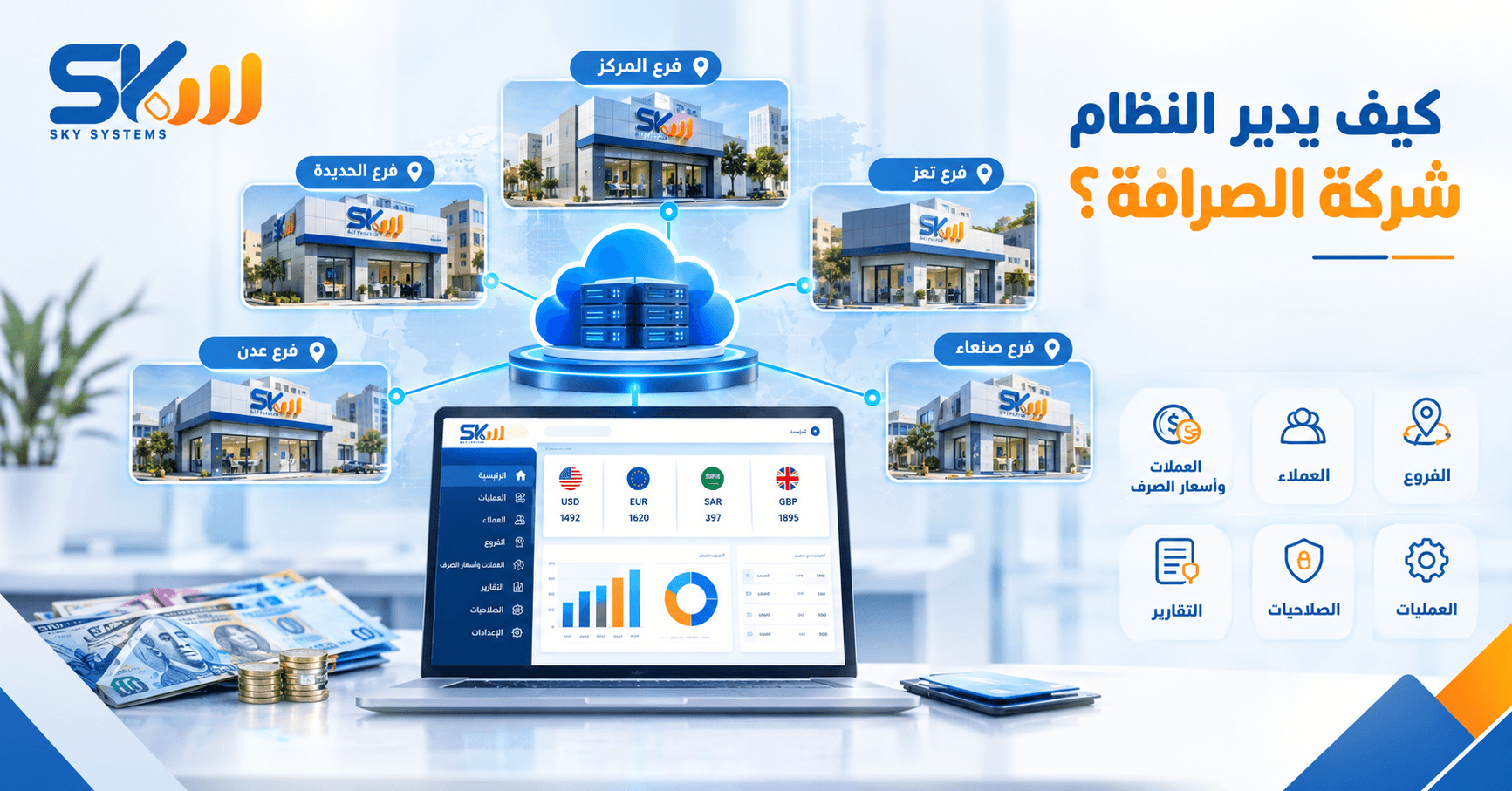
Depending on its design and permissions, the system can help organize branch data and monitor their operations through a unified system.
Instead of keeping each branch’s data separate, management can access information according to the approved permissions and configurations.
But branches are not the only part that needs to be organized.
What about customers?
The Customer Is Also Part of the System
Every financial transaction is connected to data, and the customer is one of its most important elements.
When customer data is organized within the system, it becomes easier to access related information and review previous transactions according to the available permissions.
This helps employees serve customers in a more organized way instead of manually searching through different files or records.
But recording transactions and customer data is not the end.
Management does not only need to know what transactions have taken place. It also needs to understand what is happening across the company.
From Daily Transactions to Reports
Imagine that management wants to understand the company’s performance during a specific day or period.
How many transactions were processed?
What was the volume of transactions by branch?
Which currencies were used most frequently?
How did transaction activity change during the period?
And what financial data does management need to monitor?
If data is distributed across different files and records, preparing this information can require significant time and effort.
When transactions are recorded within an organized system, however, the system can, depending on its capabilities, turn this data into reports that help management monitor operations.
This is where data becomes more than stored numbers. It becomes information that can support decision-making.
But what happens when a problem occurs in a transaction?
What If an Error Occurs in a Transaction?
In financial operations, not every procedure can be handled in the same way.
Some transactions require specific permissions, while certain actions may require review or approval according to company policy.
The system can therefore be designed to define user permissions, control access to transactions and data, and help track transactions and changes according to its capabilities and configuration.
The goal is not to make work more complicated.
It is to make responsibilities clearer and reduce the likelihood of sensitive transactions being performed without the appropriate authorization.
But does having a system mean employees no longer need to perform any manual work?
Does the System Eliminate Manual Work?
No.
The system does not eliminate the employee’s role. It helps employees work in a more organized way.
Employees still interact with customers and perform the required procedures, while the system helps them record data, access information, monitor transactions, prepare reports, and reduce repetitive tasks.
Instead of spending a significant amount of time searching through files or entering the same data repeatedly, employees can focus more on delivering the service and assisting customers.
This reveals another important benefit:
The more organized the operations are, the easier it becomes to access information.
What Happens When an Exchange Company Grows?
Growth usually means more transactions, more customers, and potentially more branches, employees, and services.
As these elements increase, managing data and operations becomes more complex.
The company may need to connect financial operations with accounting, monitor branches, manage users and permissions, generate more detailed reports, or connect the system with other services and systems.
At this point, the question is no longer:
Do we need a system?
It becomes:
Can the current system keep up with the way the company operates and grows?
Is One System Enough for Everything?
Not every company has the same needs.
One company may need a system to manage financial operations, while another may need to connect its accounting system with other systems or require additional services based on the nature of its business.
Therefore, the goal is not always to add more systems.
The goal is to ensure that systems and operations work together in an organized way and that data reaches where it is needed without unnecessary duplication.
This is where system integration becomes important when the company needs it.
But before choosing any system, there is a more important question.
What Should an Exchange Company System Provide?
A good system is not simply the one with the largest number of features.
What matters most is its ability to serve the company’s actual business needs.
For example:
Currency and exchange-rate management.
Recording financial transactions.
Customer data management.
Branch and employee management, depending on the system.
User permissions and access management.
Reports and monitoring.
Organizing data and operations.
Integration with other systems or services when needed.
Data backup and data management according to the approved technical infrastructure.
Most importantly, the system should help the company manage its operations in a clearer and more organized way.
A System Is More Than Just a Data Entry Screen
An employee may see a screen containing fields, buttons, and menus.
But behind that screen is a set of processes that enables the system to record and process data and connect it with reports, branches, and users according to its design.
This is the difference between a simple program for recording data and a system that helps manage operations.
The real value is not in the screen itself.
It is in what happens behind it.
From a Single Transaction to a Complete Picture of the Company
At the beginning of this article, we started with a simple transaction:
A customer enters the company to receive a financial service.
But when we follow that transaction inside the system, we discover that it is connected to a much larger set of data:
Customer
↓
Transaction
↓
Currency, Amount & Rate
↓
Employee & Branch
↓
Transaction Recording & Tracking
↓
Reports & Data
↓
Information That Helps Management Make Decisions
Each transaction is therefore no longer an isolated event.
It becomes part of a larger picture of the company.
In the End…
An exchange company deals with a large volume of transactions and data every day—from currencies and exchange rates to customers, branches, financial operations, and reports.
As the business grows, the real challenge is not simply completing transactions. It is organizing everything around them, monitoring it, and making use of the information generated.
This is where an Exchange Company Management System comes in.
The system helps turn daily operations into organized data, connect related information, simplify the monitoring of branches, customers, and transactions, and provide management with the reports it needs.
A good system does not simply record what happened. It helps management understand what is happening across the company.
When data is organized, monitoring becomes clearer, operations become more controlled, and decisions can be based on information rather than assumptions.
Discover Sky Systems Solutions for Financial Systems and Exchange Company Management →