Financial System Integration
When Systems Work Separately
Imagine that a sale is completed in the sales system.
The employee then needs to enter it manually into the accounting system.
Then update the inventory in another system.
If this process is repeated hundreds of times, it becomes exhausting.
Another problem may also appear:
What if the data is updated in one system but not in another?
Differences may then emerge between the systems.
And this is where the need for integration begins.
What Does System Integration Mean?
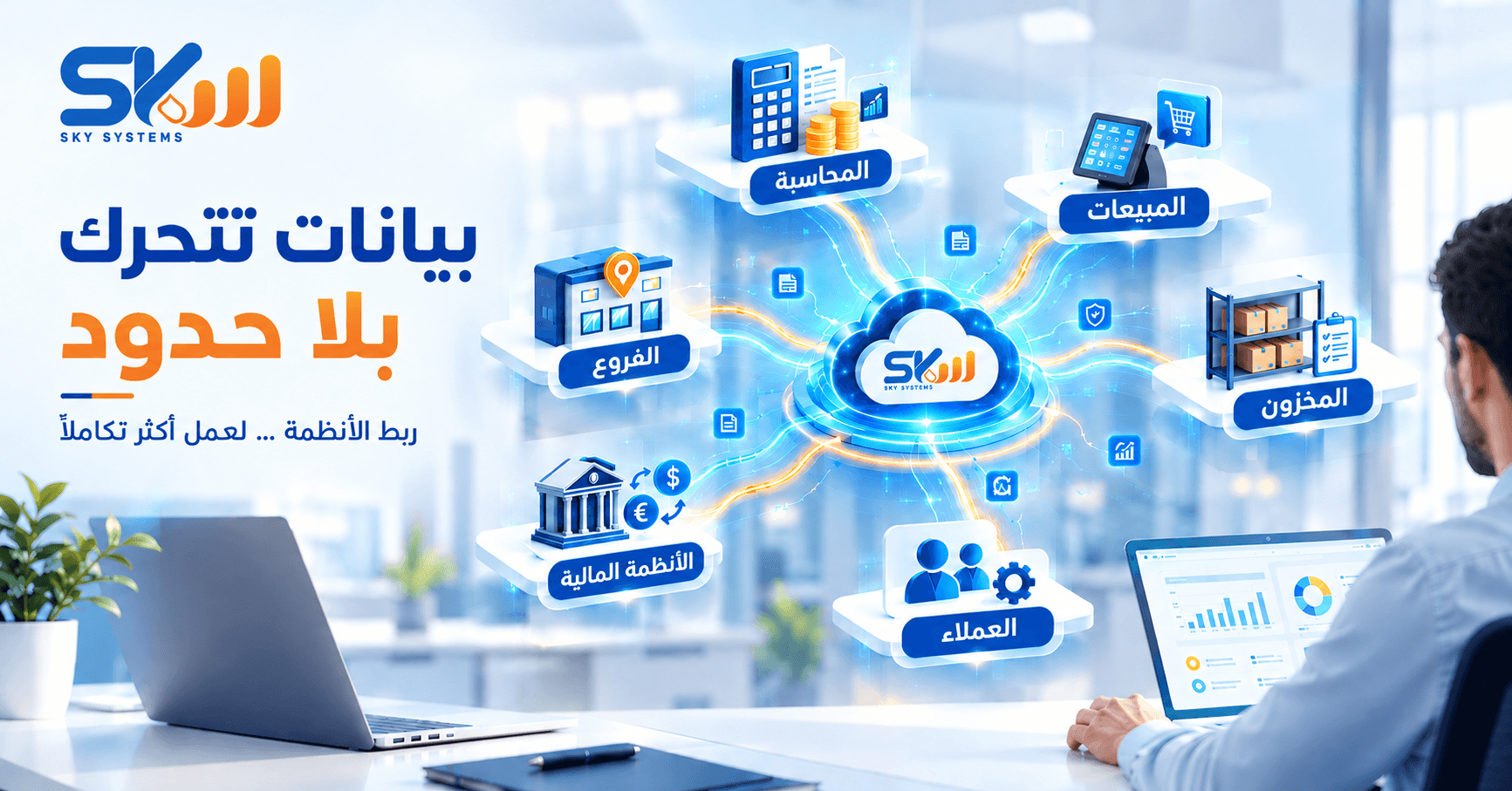
System integration means enabling two or more systems to exchange data through an organized process.
It does not necessarily mean turning all systems into one system.
Instead, the systems can remain independent while communicating with each other whenever information needs to be exchanged.
For example:
The sales system records a transaction
↓
The required data is sent to the accounting system
↓
The financial impact is recorded according to the system settings
↓
Related data is updated in other systems when needed
This allows data to move between systems instead of being entered manually in every system.
How Do Systems Communicate?
One of the most common methods used for system integration is APIs (Application Programming Interfaces).
Simply put, an API allows one system to send a request or data to another system and receive a response according to defined rules.
But successful integration does not depend on having an API alone.
It is important to determine:
What data will be transferred?
When will it be transferred?
Which system is responsible for the data?
How will errors be handled?
And how will the connection be secured?
This makes it clear that integration is not simply about “connecting two systems.”
A Simple Example from Business
Suppose a store uses a system to manage sales and inventory.
When a sale is completed, the system needs to record the sale and update inventory.
At the same time, management needs the transaction to appear in the accounting records.
If the systems are properly integrated, the required data can move between them according to the integration process.
If they are not connected, employees may need to enter the same data repeatedly.
This means additional time and a greater possibility of errors.
Does Integration Eliminate Manual Work?
Not always.
The goal of integration is to reduce the need to re-enter data and make information flow between systems more efficiently.
However, some processes may still require review, approval, or human intervention.
Therefore, integration should not be viewed as a way to eliminate employees.
It is a way to make the flow of data more organized.
Why Does Integration Become More Important as a Company Grows?
At first, a company may have one system.
Then it adds another system.
Then a new branch.
Then an application.
Then an e-commerce store.
Then a customer service system.
Each addition may create a new source of data.
Over time, the company may find itself managing multiple systems that need to communicate with one another.
And this raises an important question:
How can we maintain the flow of data without turning the company into a collection of disconnected islands?
Integration can be part of the solution.
How Does Management Benefit from Integration?
When data moves between systems in an organized way, management can gain a more complete view of the business.
This can help with:
Reducing duplicate data entry.
Reducing discrepancies between systems.
Faster information flow.
Better transaction monitoring.
Easier report generation.
Connecting related business processes.
But there is an important condition:
The integration must be designed correctly.
What Happens If Integration Is Poorly Designed?
Poor integration can create problems instead of solving them.
Data may be incomplete.
Data may be duplicated.
Updates may be delayed.
Or employees may not know which system contains the correct information.
That is why, before integrating systems, it is important to determine:
What problem are we trying to solve?
What systems are currently in place?
What data needs to be transferred?
Which system is the primary source of the data?
What situations could cause an error?
And how will the integration be monitored?
Successful integration begins with understanding the problem, not with the desire to connect systems simply for the sake of connecting them.
Do All Systems Need to Be Replaced?
Not necessarily.
Some existing systems may already be suitable for the business but simply need to communicate with other systems.
In such cases, integration may be a better option than replacing every system.
However, if legacy systems cannot support the company’s needs or integrate with the new technical environment, replacing some of them may become a logical choice.
That is why there is no single answer that works for every company.
From Separate Systems to One Connected Ecosystem
Ultimately, the goal of system integration is not to make the technology look more complicated.
Quite the opposite.
The goal is to make the journey of data simpler.
Sales data flows into accounting.
Inventory communicates with sales.
Orders reach the appropriate systems.
Digital services communicate with financial systems when needed.
This allows different systems to work as a connected ecosystem instead of operating independently.
In the End…
As a company grows, the number of systems, processes, and data sources increases.
If these systems remain completely separate, data can become scattered, information may need to be entered repeatedly, and obtaining a clear view of the business can become more difficult.
But when integration is designed properly, systems can exchange data, organize information flow, and reduce repetitive work.
Integration is not the goal itself.
The goal is to ensure that the right information reaches the right place, at the right time, in a way that helps the company operate more efficiently and in a more organized manner.
And ultimately:
A good system organizes the process. A good integration makes systems work together.
Discover Sky Systems Solutions for Financial Systems and System Integration →