
Digital Wallets
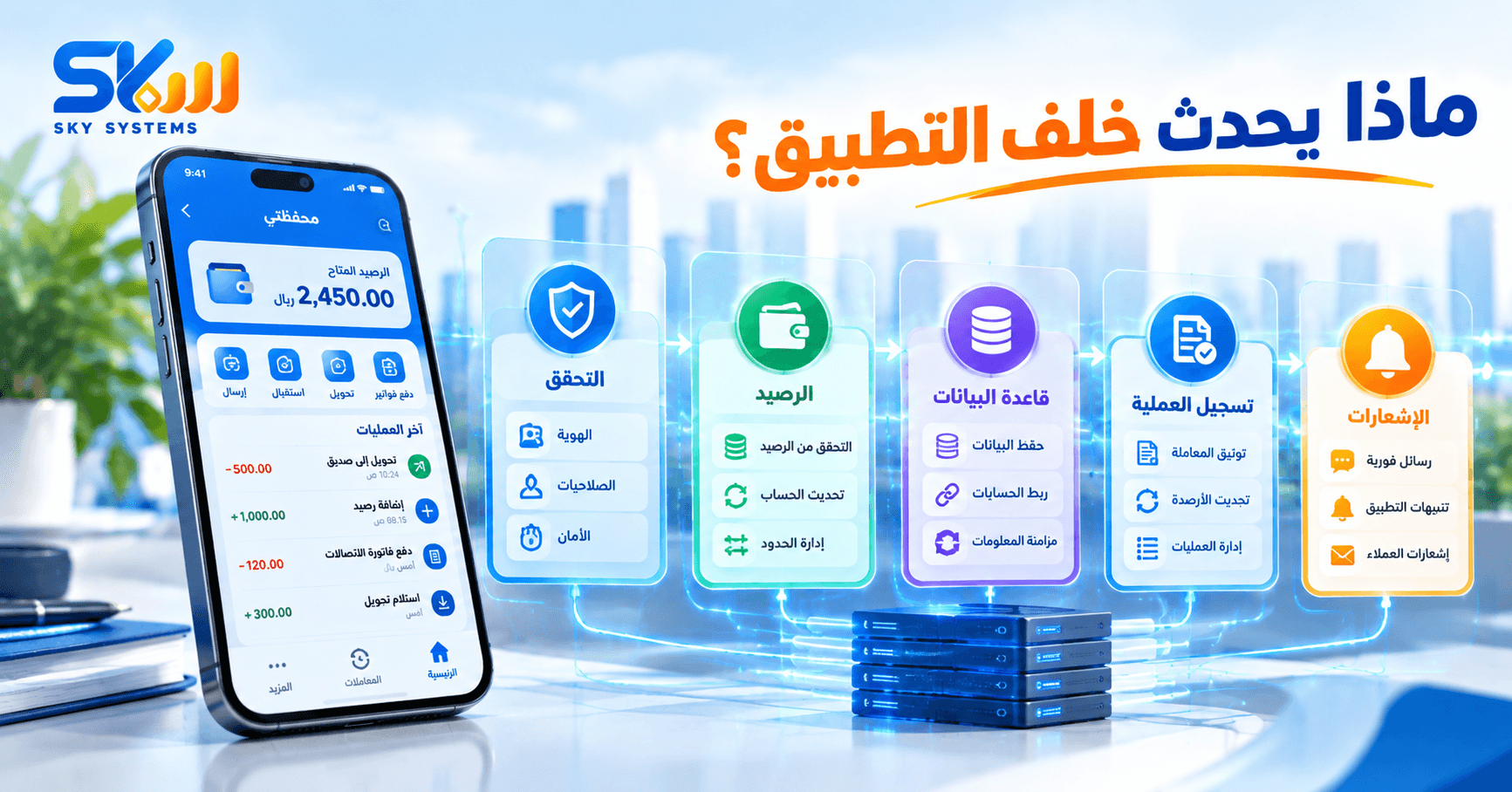
A Digital Wallet Is More Than Just an App
When we say “digital wallet,” we may immediately think of the mobile application used by the customer.
But the application is only the part that the user interacts with directly.
Behind it, there are systems, databases, and services working together to manage accounts, transactions, balances, and the services available to the user.
The application sends the user’s request, while the systems behind it process that request, verify it, record the result, and then return the outcome to the application.
In simpler terms:
The user sees the application… but the actual transaction does not happen on the screen alone.
So, what happens when a user logs in?
The First Step… Identifying the User
Before a user can access their wallet, the system needs to verify their identity according to the approved login mechanism.
Once verification is successful, the system identifies the account associated with the user and determines which services and permissions are available to them.
The wallet can then display the information related to that account, such as the balance, transactions, and available services.
But seeing a balance on the screen raises an important question:
Where did that number come from?
How Does the System Know the User’s Balance?
The balance displayed to the user is not simply a fixed number stored inside the application.
It is the result of financial transactions recorded on the account according to the system’s rules.
When a user adds funds, receives a transfer, pays a bill, purchases a service, or transfers money to another user, these transactions affect the account according to the type of transaction and the system’s procedures.
As a result, the balance changes based on the recorded transaction activity.
And this brings us to an important point:
A wallet does not only need to know the current balance. It also needs to know how the account reached that balance.
This leads us to the transaction history.
Every Transaction Leaves a Record
Imagine that a user performs several transactions during a week:
They add funds, transfer money, pay a bill, and receive money from another person.
If the user only sees the final balance, they will not know how the account changed.
That is why digital wallets typically include a transaction history showing the activity recorded on the account.
Depending on the system design, the history may include information such as the transaction type, amount, date, status, and the related party.
This allows users to review their previous transactions, while authorized systems and teams can monitor transactions from an operational and financial perspective.
But what happens when the user taps “Transfer”?
What Happens When Money Is Transferred?
Suppose a user wants to transfer money to another user.
They enter the beneficiary’s number or the required information, specify the amount, and confirm the transaction.
From the user’s perspective, it is simply a few steps on the screen.
But behind the screen, another series of processes begins.
The system receives the transfer request, verifies the required information, checks the account status, and validates the conditions and permissions associated with the transaction.
If the transaction meets the required conditions, it is recorded and the related accounts are updated according to the system’s process.
The result is then returned to the application.
This is why a transfer may appear to take only a few seconds to the user, while several sequential steps take place behind the screen.
But what happens if there is not enough balance?
What If the Balance Is Not Enough?
The system is not expected to execute every request it receives.
When a financial transaction is initiated, the system must apply the conditions and rules associated with it.
Depending on the type of transaction, this may include checking whether sufficient funds are available and whether the required conditions have been met.
If the conditions are not satisfied, the system may reject or stop the transaction and display the appropriate result to the user.
This highlights one of the key functions of financial systems:
They do not simply record transactions. They apply the rules that govern how those transactions are executed.
But what happens when the transaction succeeds?
What Happens After a Successful Transaction?
Once the transaction is completed, it is recorded and the related data is updated according to the system’s process.
The sender’s balance may change, the beneficiary’s balance may change, the transaction details may be recorded, its status may be updated, and the result is then displayed to the user.
So, when the user sees:
“Transaction successful”
it means that the system has completed a series of processes associated with the transaction, not simply changed a message on the screen.
But what if the transaction does not succeed?
What Happens If the Transaction Fails?
A transaction may fail for different reasons, such as a missing requirement, a connectivity issue, an unavailable service, incorrect data, or other reasons depending on the nature of the system.
This is where the transaction status becomes especially important.
Not every request received by the system necessarily means that the transaction was successfully completed.
A transaction may be new, in progress, successful, rejected, or in another status depending on the system design.
These statuses help clarify what happened to the transaction instead of leaving the user or employee with an unclear result.
But what happens when the user needs to pay a bill instead of transferring money?
A Digital Wallet Is More Than Money Transfers
A digital wallet can provide a range of services depending on the nature of the system and its operator.
For example:
Mobile credit top-ups.
Bill payments.
Purchasing certain services or products.
Money transfers.
Receiving money.
Requesting money to be sent or received.
Transfers between accounts.
Currency exchange in systems that support it.
Other services that can be added and integrated with the wallet.
These services may appear to the user as if they all exist within a single application.
But behind each service is a different process that requires appropriate rules, procedures, and integrations.
And this brings us to an important question:
How can a wallet provide a service that is handled outside its own system?
Does the Wallet Work on Its Own?
In many cases, it does not.
A wallet may need to communicate with other systems and services to execute certain transactions.
For example, when paying a bill, topping up mobile credit, or using a service provided by an external party, the wallet needs to send the required information to the relevant service or connected system, receive the result, and then update the transaction status within the wallet.
This is where an important concept comes into play:
System integration.
A wallet becomes more effective when it can communicate with other services and systems in an organized way.
But how does this communication take place?
How Does a Wallet Communicate with Other Systems?
Systems use different technical methods to communicate with one another. One of the most common is APIs (Application Programming Interfaces).
Simply put, an API can be thought of as an organized way for one system to send a request to another system and receive a response according to defined rules.
For example:
The wallet sends a mobile top-up request
↓
The connected system receives the request
↓
The transaction is processed according to the approved procedures
↓
The result is returned to the wallet
↓
The result appears to the user
This allows the user to complete the service from within the wallet without having to switch between multiple applications.
But integration is not only about providing services.
What does management gain from all these transactions?
From User Transactions to Management Information
Every transaction performed within a wallet generates data.
As thousands or millions of transactions accumulate, a large amount of information becomes available for management to monitor.
How many transactions were made?
What types of transactions are most commonly used?
What is the total transfer volume?
Which transactions were successful or rejected?
How are accounts moving?
And which services are used the most?
When this data is organized within the system, it can be used for reporting, monitoring, and analysis, depending on the system’s capabilities.
This is where the wallet becomes more than just a tool for executing transactions.
It becomes an important source of information that helps management understand financial and operational activity.
But what happens when the number of users increases?
As the Wallet Grows… So Does the Challenge
A wallet may start with a limited number of users and transactions.
But as the service grows, the number of users and transactions can increase significantly.
This creates new challenges:
How can this number of accounts be managed?
How can a large number of transactions be processed?
How can errors and issues be monitored?
How can service speed be maintained?
And how can management access the data it needs?
As the wallet grows, the need for a technical infrastructure and systems capable of handling that growth also increases, along with the need for better organization of data, transactions, and services.
But growth is not only about the number of users.
What about protecting data and transactions?
What About Wallet Security?
A digital wallet handles financial data and transactions, making the protection of accounts, data, and transactions an essential part of designing and operating financial systems.
Depending on the system and its configuration, security mechanisms may include user and permission management, transaction verification methods, data protection, transaction logging, backups, and system monitoring.
The goal is for transactions to be:
Organized, traceable, and executed according to defined permissions and rules.
But what happens when a company needs to add a new service to the wallet?
A Wallet Can Evolve with Business Needs
One of the strengths of digital systems is the ability to develop services and add new integrations according to the company’s needs.
A wallet may start with basic services and later need to connect with payment services, accounting systems, e-commerce platforms, messaging and notification services, or other systems.
This is where the architecture on which the wallet is built becomes especially important.
If the systems are designed to support integration and scalability, it becomes easier to develop services and add new capabilities according to technical and operational requirements.
This means a wallet is not simply an application launched once and left unchanged.
It is a system that can evolve as the needs of users and the company evolve.
The Journey of a Transaction Inside the Wallet
If we want to summarize everything that happens behind the application, we can visualize the process like this:
The user requests a service
↓
The application sends the request
↓
The system verifies the data and conditions
↓
The transaction is processed according to the approved rules
↓
The transaction is recorded and the data is updated
↓
The transaction status and balance are updated when needed
↓
The wallet communicates with other systems if the service requires it
↓
The result appears to the user
↓
The transaction becomes part of the records and reports
This reveals that a single tap on the application may trigger an entire chain of technical and financial processes behind the scenes.
In the End…
The user may see a simple application:
Balance, transfers, bill payments, mobile top-ups, and transaction history.
But behind this interface are systems that manage accounts, data, transactions, services, integrations, and reports.
When a user transfers money, it is not simply a matter of moving a number from one screen to another.
Instead, a complete process begins: verifying the request, processing the transaction, recording it, updating the data, and displaying the result to the user.
When the user pays a bill or tops up mobile credit, the wallet may communicate with other systems to complete the service and return the result.
And as the number of users and transactions increases, the importance of technical infrastructure, integration, and data management becomes even greater.
That is why a digital wallet is not simply a mobile application.
It is an integrated system that operates behind the application to make financial transactions and digital services possible, simple, and accessible to the user.
The user sees the result in seconds… while the system manages the entire journey behind the screen.
And this is where the true value of technology becomes clear:
Making complex financial processes work in the background while giving users a simple, clear, and fast experience.
Discover Sky Systems Solutions for Digital Wallets, Integration, and Digital Services →