How to Manage Your Business the Right Way?
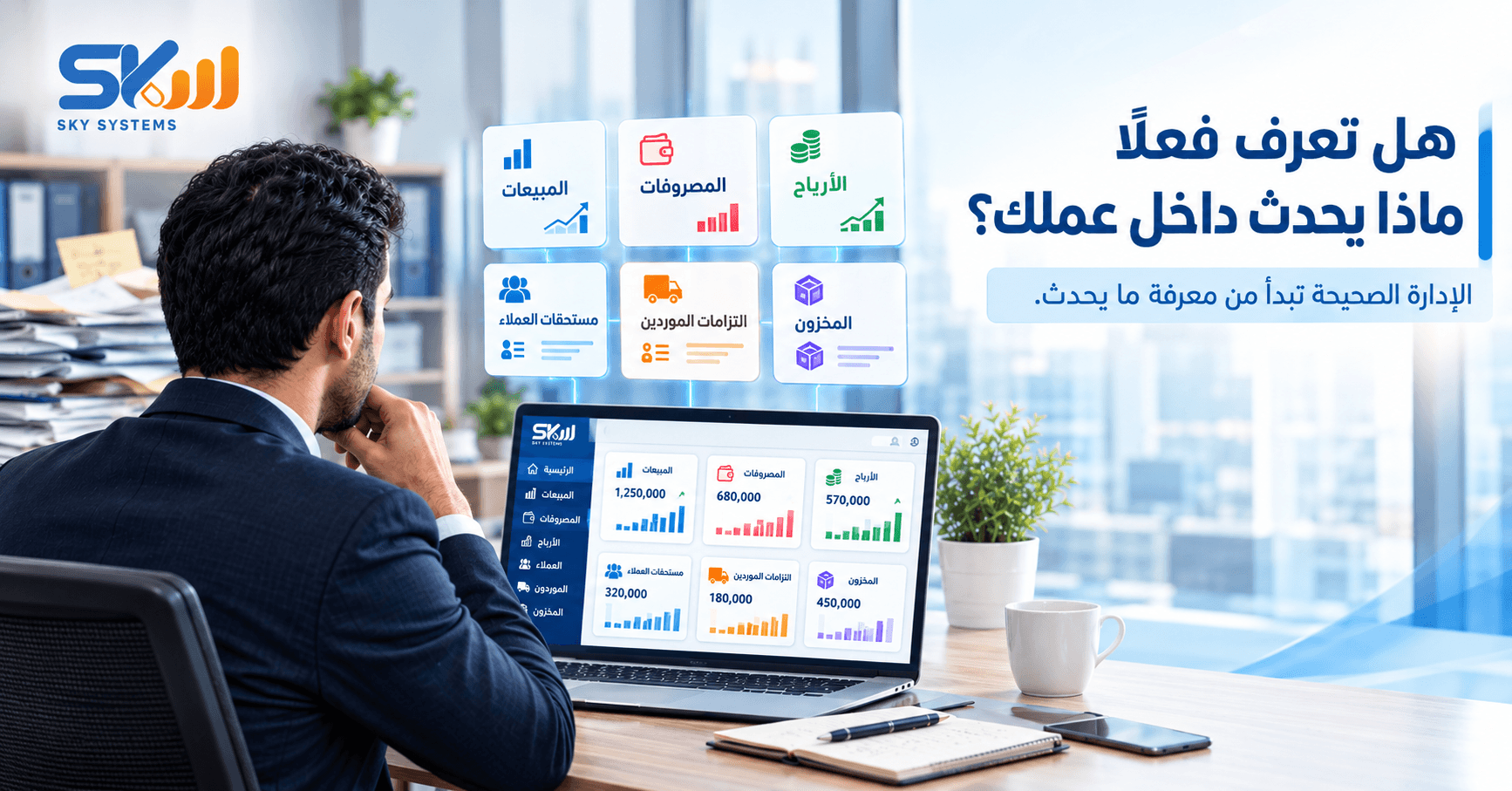
How to Manage Your Business the Right Way?
You may know how much you sold, but do you know how much you actually earned?
You may know that money is coming into your business, but do you know where it is going?
You may know your customers and suppliers, but do you know exactly who owes you and whom you owe?
And you may have dozens of files and reports, but when you need a specific number...
Can you find it within minutes?
If answering these questions requires a long search, asking several employees, or going through multiple files, then perhaps the problem is not your business itself.
Perhaps the problem is how your business information is being managed.
And that is where the story begins.
Sales Are Good... But Where Is the Profit?
Let’s say your sales increased this month.
Great.
Your first reaction may be that the business is doing better.
But before you celebrate, ask yourself:
Did your profits increase as well?
Your sales may be higher, but your expenses may have increased too.
You may have a large number of credit sales, but the money has not been collected yet.
You may also have outstanding obligations and expenses whose full impact is not yet clear.
That is why sales are not the same as profit.
Sales tell you what you sold, but they do not, by themselves, tell you what you actually kept.
That is why a business owner who wants to understand the true state of the business should not only ask:
“How much did we sell?”
They should also ask:
“After expenses, costs, and outstanding amounts... how much did we actually earn?”
This is where the first difference between monitoring and managing a business becomes clear.
Monitoring tells you what happened. Management helps you understand what it means.
So... Where Is Your Business Money Going?
Money comes in through sales.
Then money goes out for purchases, salaries, rent, operating expenses, obligations, and more.
At the beginning of a business, keeping track of all of this may be relatively easy.
But what happens as the business grows?
Dozens of invoices.
Hundreds of transactions.
Different customers.
Multiple suppliers.
And expenses occurring every day.
Then, at the end of the month, a question appears that no business owner wants to struggle to answer:
“Where did our money go?”
If answering that question requires searching through invoices, notebooks, files, and messages, that is a sign that your information needs better organization.
Because it is not enough for money to simply come in and go out.
You need to understand how it moves.
When financial transactions are properly organized, it becomes easier to know what happened, when it happened, and how it affected your business.
That is when numbers stop being nothing more than stored data...
and become information that helps you understand your business.
Who Owes You? And Whom Do You Owe?
A customer may owe you money.
You may owe money to a supplier.
One customer may have paid only part of what they owe.
A supplier may have received only a partial payment.
At first, you may be able to remember all of this.
But as the number of customers, suppliers, and transactions increases, memory becomes an unreliable way to manage your accounts.
So ask yourself:
Do I know, at any given moment, how much each customer owes me?
Do I know how much I owe each supplier?
Do I know what has been collected and what is still outstanding?
These are not minor details.
They are an essential part of your business’s financial picture.
When this information is properly organized, you can track your receivables and payables more clearly instead of relying on memory or searching through scattered files.
What About Your Inventory?
You may be selling well, but do you know what is happening with your inventory?
What products came in?
What products went out?
How much is left?
Which products are moving quickly?
And which products need attention?
Inventory may seem like a separate issue from accounting, but it is directly connected to your business.
Every purchase affects inventory.
Every sale moves it.
And any error in tracking inventory can affect your sales, costs, and accounts.
That is why understanding inventory movement is part of understanding the true state of your business.
Now Imagine You Need Just One Number...
The manager arrives in the morning and asks:
“How much were our sales this month?”
Does the number appear immediately?
Or does the search begin?
One file for sales...
Another for expenses...
One employee reviews the invoices...
Another verifies the figures...
And eventually, the answer appears.
But what if the next question is:
“How much were our expenses?”
Then:
“How much do our customers owe us?”
Then:
“How much do we owe our suppliers?”
Every question requires another search.
And this brings us to an important point:
The time you spend searching for information is time you are not spending managing your business.
Good management does not mean memorizing every number.
It means knowing where to find the number you need, and when you need it.
Do You Know What Is Happening in Your Business Right Now?
Knowing what happened last month is important.
But do you know what is happening right now?
Are your sales performing as expected?
Are expenses increasing?
Are there overdue receivables?
Does your inventory need to be reorganized?
Are there transactions that require follow-up?
These questions do not require guesswork.
They require clear information.
Because the decision you make today depends on what you know today.
And the later the information reaches you, the later the decision may come.
That is why the value of data is not simply in having it.
Its real value comes from having it available when you need it.
When Do Too Many Files Become a Problem?
At the beginning of a business, using Excel or separate files may be practical and perfectly reasonable.
One file for sales.
One for expenses.
One for customers.
One for suppliers.
And another for inventory.
There may be no major problem at first.
But your business does not stay the same.
Transactions increase.
The number of employees grows.
The number of customers grows.
And the amount of data grows with them.
Then the questions begin:
Which file is the latest?
Has this information been updated?
Is the number here the same as the number in the other file?
Who changed the data?
The problem here is not Excel itself.
The problem begins when the way you manage your business becomes more complex than the tool you are using to manage it.
At that point, you may not need another file.
You may need a more organized way to manage the business as a whole.
Do You Really Need an Accounting System?
Not every business needs the same tools.
But there comes a point when an important question begins to emerge:
Is my current way of working still capable of keeping up with the size of my business?
If tracking sales and expenses takes too much time...
If customer and supplier accounts have become difficult to monitor...
If reports require manual preparation...
If your data is scattered across multiple places...
If understanding your financial position requires significant effort...
Then it may be time to consider an accounting system that can help organize these processes.
But keep one thing in mind:
The system itself is not the goal.
The goal is to make managing your business clearer, easier, and more organized.
What Does an Accounting System Actually Do?
Some people may think that an accounting system is simply a place to record invoices.
But its role can be much broader.
It can help organize business processes and the information connected to them, including:
Sales and purchases.
Expenses and revenues.
Customer and supplier accounts.
Inventory movement.
Financial and management reports.
More importantly, this information does not remain as a collection of separate numbers.
When business processes are organized and connected, accessing information becomes easier, and understanding the numbers becomes clearer.
Instead of asking:
“Where is the information?”
You can move on to the more important question:
“What is this information telling me about my business?”
That is the real difference.
Does the System Make Decisions for You?
No.
A system does not know the nature of every decision you need to make.
And it cannot replace your experience or your understanding of your market, your business, and your customers.
But there is something it can provide:
A clearer view.
When you know your sales, expenses, receivables, obligations, inventory movement, and reports...
you have the information you need to understand the situation more clearly.
Then comes your role:
You understand the numbers, evaluate the situation, and make the decision.
The system does not manage your business for you.
It helps you manage your business while giving you a clearer view of the bigger picture.
So... What Does Good Management Really Mean?
Good management is not about being busy all day.
It is not about reviewing everything yourself.
And it is not about having the largest number of files.
Good management begins when you can answer the important questions at the right time:
How much did we sell?
How much did we spend?
How much did we earn?
How much are we owed?
How much do we owe?
What is happening with our inventory?
And what needs attention?
When the answers are clear, it becomes easier to move beyond simply tracking what happened...
and start understanding what needs to happen next.
Before You Leave... Try This Test
Close this article for a moment and ask yourself:
If someone asked you right now for your net profit, would you know the answer?
What if they asked:
How much do your customers owe you?
Could you answer immediately?
How much do you owe your suppliers?
Is the number clear?
What is the value of your inventory?
Can you access it easily?
How much have you spent recently?
Would you need to search for the answer?
If the answers are readily available, it means you have a good level of organization.
But if you find yourself thinking:
“Wait... let me check the file.”
Then:
“Maybe the employee knows.”
Then:
“I need to collect the numbers first.”
That does not mean your business is doing poorly.
It simply means there may be an opportunity to improve the way your business information is managed.
In the End... You Don’t Need More Numbers
You may think the solution is to collect more data.
But the reality is different.
What matters is not having more numbers.
What matters is having numbers that are:
Organized.
Clear.
Connected.
And easy to access.
Because a number you cannot access at the right time—or cannot understand—will not help you much when making a decision.
That is why good management does not begin with doing more work...
It begins with having a clear view of what is happening inside your business.
And when technology and an accounting system help you achieve that clarity, numbers become more than just reports.
They become a tool that helps you see your business, understand its reality, and make decisions based on real information.
Always remember:
You do not need to know everything from memory...
You simply need the information you need to be available when you need it.
Because you cannot manage what you cannot clearly see.
Discover Sky Systems solutions for accounting and business management →