
Finance & Financial Technology
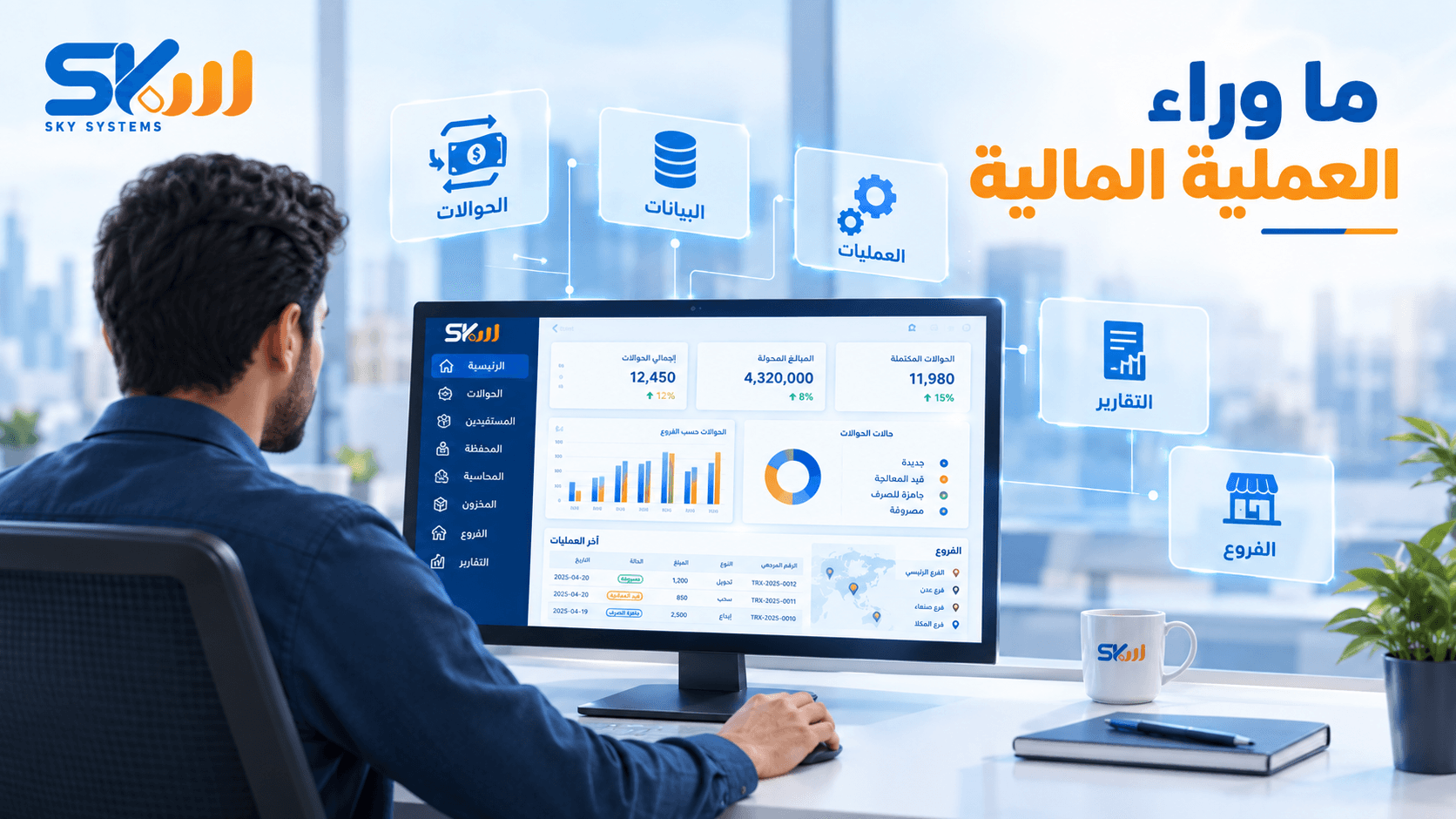
What Happens Behind the Scenes When a Financial Remittance Is Processed?
When a customer requests a financial remittance, the process may appear simple and fast: the employee enters the data, the remittance is approved, the customer receives its reference number, and the process seems to be complete.
But is it really complete?
What happens after the employee clicks “Send”?
How does the system verify the data?
Where is the remittance recorded?
How does the system know its status?
How does its information reach the payout location?
And what happens if the beneficiary does not collect the remittance?
Behind what appears to be a simple remittance, there is an entire journey taking place in the background.
Every Remittance Starts with Data
When a customer requests a remittance, the employee enters the information required for the transaction, such as the sender’s and beneficiary’s details, the amount, the currency, and the branch or destination associated with the remittance.
But an important question arises here:
Is entering the data and clicking “Send” enough?
Not necessarily.
This is only the beginning of the remittance’s journey inside the system.
Before the Remittance Moves… the Data Must Be Verified
After the data is entered, the system processes it according to the rules, procedures, and permissions defined for the transaction.
This may include verifying that all required information is complete, checking user permissions, and confirming the requirements needed to approve the transaction.
This is where one of the system’s most important functions becomes clear:
It does not simply store data. It also helps organize the process before the transaction is approved.
But after the remittance is approved, where does this data go?
From Data on the Screen to a Traceable Remittance
Once the transaction is approved, the remittance is recorded in the system and a dedicated record is created containing its key details. It is also assigned a reference number that can be used to retrieve it later.
This is an important point:
The remittance now has an identity within the system.
It is no longer just data entered by an employee. It has become a transaction that can be searched, tracked, and reviewed to understand what has happened to it.
But how does the system know where the remittance has reached?
A Remittance Does Not Remain in One Status
From the moment a remittance is created until it is paid out, it may pass through several statuses depending on the nature of the system and the procedures in place.
For example:
New → Ready for Payout → Processing → Paid
There may also be other statuses depending on the system design and the nature of the remittance network.
The remittance status helps employees, management, and authorized users understand its current state.
But what happens if the remittance remains unpaid?
What Happens If the Beneficiary Does Not Collect the Remittance?
A remittance may remain unpaid for several reasons. The beneficiary may not arrive, the transaction may require further review, or there may be an issue with the data or payout procedures.
In such cases, the remittance does not simply disappear from the system.
The transaction remains recorded with its current status, allowing authorized users to review it, track what happened, and take the appropriate action according to the approved procedures.
This highlights the importance of having a system capable of tracking transactions instead of relying on memory or manually searching through files.
But what if an employee discovers an error in the remittance data?
What If There Is an Error in the Remittance Data?
In financial operations, not every action should be available to every user.
The system can be designed so that certain sensitive operations are restricted to specific permissions or require review before changes can be made. Changes can also be recorded depending on the capabilities and configuration of the system.
The goal is to ensure that the transaction remains:
Clear, organized, and traceable.
The remittance can then continue through its normal process until it reaches the payout stage.
At the Payout Stage… Is the Remittance Finished?
When the remittance is paid out, the payout transaction is recorded and its status is updated within the system.
This makes the remittance journey clear:
Creation → Verification → Recording → Tracking → Payout
But does the remittance disappear from the system once it has been collected?
Of course not.
The transaction becomes part of the transaction history, which can be accessed later when needed.
And this brings us to a bigger question:
What happens when there is not just one remittance, but hundreds or thousands?
When Remittances Reach the Thousands… the Real Challenge Begins
Processing a single remittance is relatively simple.
But what about company processing hundreds or thousands of remittances every day?
How can employees know the status of every remittance?
How can management know which transactions have been paid and which remain unpaid?
How can a transaction from days or weeks ago be found?
And how can the company ensure that its data is organized and that no transactions are lost among scattered files?
As the volume of transactions increases, relying on scattered files and manual procedures becomes increasingly difficult.
This is where the real value of a system becomes clear.
A system helps organize large numbers of transactions, record and classify them, track their statuses, and make them accessible whenever needed.
What Happens When the Company Has Multiple Branches?
Managing a single branch makes monitoring relatively simple.
But when a company operates across multiple branches, the picture becomes more complex.
Management needs to know:
What is happening at each branch?
How many transactions have been processed?
Which transactions have been paid?
Which transactions are still being followed up?
What data is associated with each branch?
How can information be accessed without waiting for it to be collected manually?
Systems designed to manage networks and branches can help organize and monitor data and transactions according to approved permissions and configurations.
But there is a benefit that goes beyond simply tracking remittances.
Every recorded remittance means more data.
From Remittances to Reports
A remittance is not simply a financial transaction that ends once it is paid.
Every recorded transaction adds data to the system.
As hundreds or thousands of transactions accumulate, this data becomes an important source of information for management.
Depending on its capabilities, the system can provide reports that help identify:
Transaction volumes.
Transactions by branch.
Remittance statuses.
Financial data associated with transactions.
Indicators that help management monitor operations and make decisions.
This is where the role of the system moves beyond simply recording transactions to helping management understand what is happening across the business.
Does a System Eliminate Manual Work?
Some may assume that having a system means employees will no longer need to perform any manual procedures.
But that is not the goal.
A system does not eliminate the employee’s role. It helps employees work in a more organized way.
A system can help:
Reduce repetitive data entry.
Speed up procedures.
Make it easier to search for transactions.
Track remittance statuses.
Reduce errors caused by repeated manual entry.
Provide management with the information it needs at the right time.
The goal of technology is not to replace employees, but to reduce repetitive tasks and create more room for monitoring and decision-making.
What About Remittance Data?
Remittances contain financial data and transactions, which makes managing access to and protecting this information an important part of building financial systems.
Systems may include mechanisms such as:
User permissions.
Data access controls.
Recording transactions and changes, depending on the system.
Data backups.
Data protection.
Technical infrastructure management.
The core idea is that financial data needs to be managed in an organized and secure way, especially as the volume of transactions, users, and branches increases.
The Journey of a Remittance Behind the Screen
If we want to summarize everything that happens, the remittance journey can be visualized as follows:
Data Entry
↓
Transaction Verification
↓
Remittance Creation
↓
Recording with a Reference Number
↓
Status Update
↓
Remittance Tracking
↓
Payout
↓
Record Update
↓
Reporting
↓
Data Utilization
This shows that a remittance is not simply the act of sending money from one person to another.
It is an integrated chain of data, procedures, tracking, and records.
In the End…
A remittance may appear to the customer as a simple and fast transaction, but in reality, it is a journey that begins with data entry and continues through verification, recording, tracking, and status updates until payout, after which it becomes part of the company’s data and reports.
As the number of remittances and branches increases, the challenge is no longer simply executing transactions. It becomes about managing, monitoring, and understanding all the details behind them.
This is where the importance of a financial system becomes clear. It does more than record a remittance. It helps organize its journey, identify its status, track transactions, and provide management with the information it needs.
A good financial system does not simply tell you what happened… it helps you understand what is happening.
And this is the value of technology when it is applied in the right place:
It allows complex processes to run in the background while giving management a clearer picture of the business.
Discover Sky Systems Solutions for Financial Systems and Remittance Networks →